


It starts with EU food contact legislation
Food handling gloves fall under the wider European legislation governing all food contact materials.
The two most important pieces of legislation are:- Framework Regulation (EC) No. 1935/2004 on materials and articles intended to come into contact with food.
- Commission Regulation (EU) No.10/2011 for plastic materials intended to come into contact with food, which specifies compositional requirements and migration limits for plastic food contact materials.
Good manufacturing practice is also required under Commission Regulation (EC) No. 2023/2006
Together these regulations require that materials coming into contact with food must not:- Endanger human health
- Cause an unacceptable change in the composition of food
- Alter the taste, smell or appearance of food
Food safe isn’t simply a label, it’s the result of rigorous migration testing designed to ensure glove materials remain safe when used in contact with food.
Understanding how Regulation EC 1935/2004, Commission Regulation EU 10/2011 and the EN1186 migration test methods work helps safety professionals make more informed decisions when selecting hand protection for food manufacturing.
What does the glass and fork symbol mean?
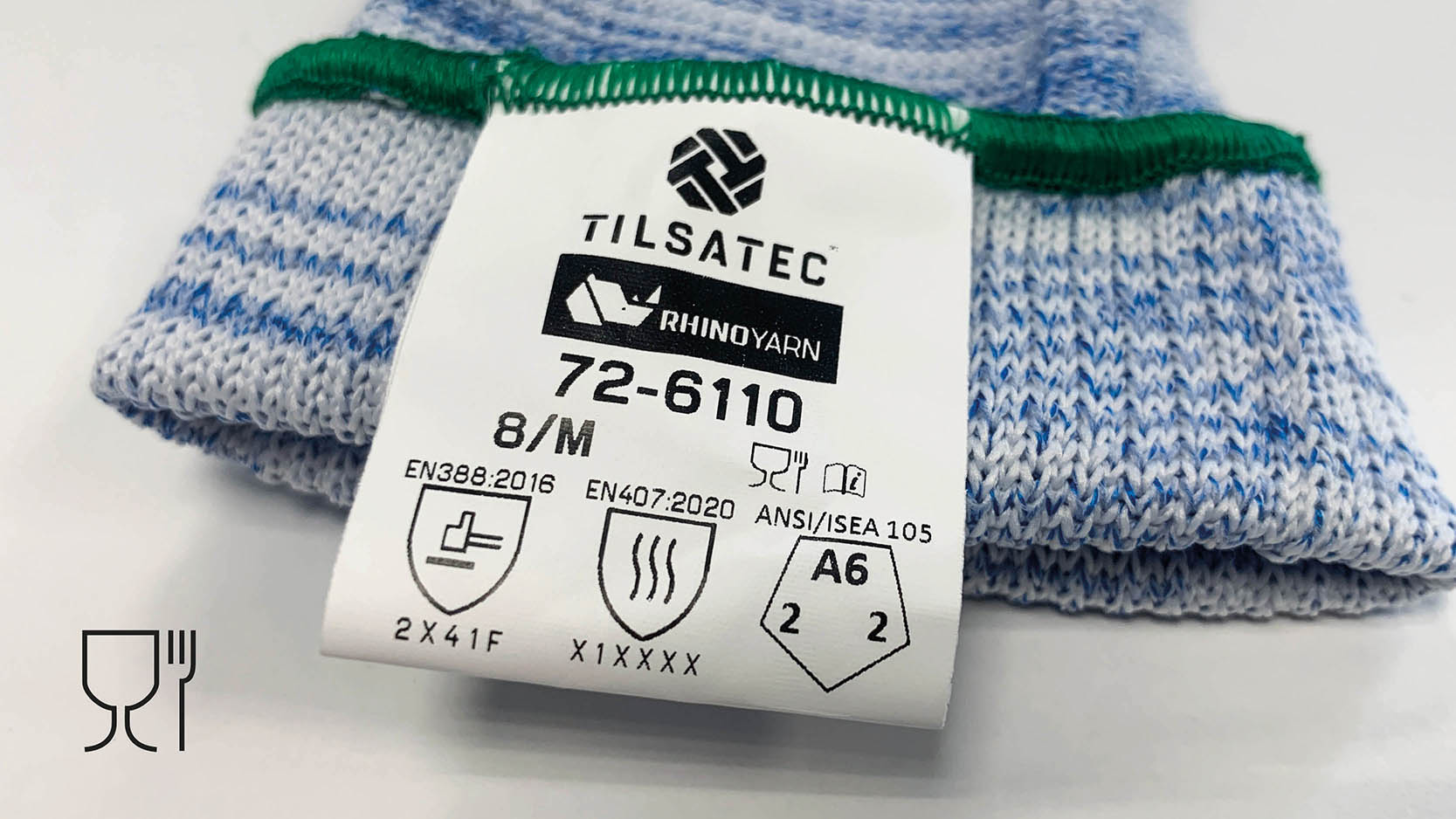
If you’ve ever looked closely at food handling gloves, utensils or food packaging, you’ve probably noticed a small symbol showing a wine glass and fork.
This is the internationally recognised symbol used to indicate that a material is suitable for contact with food. However, it’s often misunderstood.
The symbol is not a quality mark or certification awarded by an independent body. Instead, it is a declaration by the manufacturer that the product complies with the relevant European food contact legislation.
For reusable gloves and textiles, this means the materials have been assessed against the applicable food contact regulations, including Framework Regulation (EC) No. 1935/2004 and, where relevant, Commission Regulation (EU) No. 10/2011 for plastic components. Demonstrating compliance typically involves migration testing carried out using the EN1186 series of test methods to confirm that substances migrating from the material into food or food simulants remain below the permitted limits.
When you see the glass and fork symbol on a glove, it tells you that the product has been designed and tested for food contact, not simply that it offers cut resistance or mechanical protection.
That distinction is important. A glove may provide excellent protection against cuts, but unless its materials have also been assessed for food contact, it shouldn’t automatically be assumed to be suitable for handling food.
Where does EN1186 fit in?
EN1186 is not a glove performance standard.
Instead, it is a series of laboratory test methods used to measure migration of substances from food contact materials into food simulants.
Migration simply means:
How much of the glove material could transfer into food during normal use?
Rather than testing against every food type imaginable, laboratories use carefully formulated food simulants that represent different food groups.
These include food simulants representing:- Aqueous foods
- Acidic foods
- Alcoholic foods
- Fatty foods
The glove material is exposed to these simulants under controlled temperatures and contact times designed to represent real food production environments.
The amount of material that migrates from the glove is then measured.
If migration remains below the limits defined within EU legislation, the product can be considered suitable for repeated food contact.
What is migration testing looking for?
The testing measures two different things.
Overall Migration
This measures the total quantity of non-volatile substances that migrate from the glove material into a food simulant under defined test conditions.
Think of it as measuring the total amount of transferable substances released from the glove.
Specific Migration
Certain individual substances have their own specific migration limits because of their chemical properties and potential impact on food safety.
Testing confirms these substances remain below permitted thresholds.
Both overall and specific migration testing help demonstrate that gloves won’t contaminate food during normal use.
Does passing EN1186 mean a glove is hygienic?
Not necessarily. Food contact compliance only confirms that the glove materials are suitable for food contact and that any migration of substances remains within permitted limits.
- Cut resistance
- Grip
- Comfort
- Durability
- Laundering performance
- Fibre shedding
- Ease of identifying damage
- Suitability for the specific food process
For example, a glove used for meat deboning has very different performance requirements from one used for secondary packing or food distribution.
Food safety is only part of the picture
Many food manufacturers are also looking for gloves that help reduce contamination risks.
- Antimicrobial treatments
- Glass fibre-free constructions
- Industrial wash durability
- High visibility colours
- Appropriate cut protection for the task
Antimicrobial treatments are often applied as a finish or coating to the glove surface. The durability of these treatments can depend on the chemistry used, the application method and the laundering conditions the glove is exposed to.
Our antimicrobial technology takes a different approach, with the antimicrobial properties incorporated directly into the yarn during manufacture. This means the antimicrobial agent is embedded within the fibre structure rather than applied only to the surface of the glove. As a result, the antimicrobial properties are designed to remain present throughout the glove’s intended service life, including the rigorous industrial laundering cycles required for reusable food processing gloves.
Selecting the correct glove is therefore about balancing food safety compliance with worker protection and operational efficiency.
Choosing the right glove for the application
Different areas of food production present different hazards.
Primary meat processing often requires the highest cut resistance together with arm protection.
Secondary processing may prioritise dexterity and grip.
Packing operations may need lightweight cut protection with excellent tactile feel.
Distribution and logistics frequently require durable coated gloves that provide grip while remaining suitable for incidental food contact.
Rather than relying on a single glove across every operation, selecting PPE according to the specific application helps improve both safety and productivity.
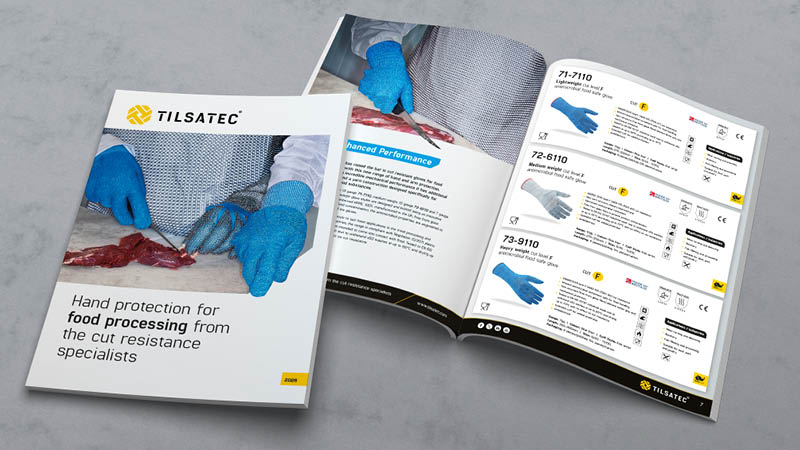
Our latest Food Safe Hand Protection Guide explains which glove styles are best suited for different areas of food processing. From slaughter and deboning through to packing, distribution and general handling, whilst highlighting the features designed specifically for demanding food manufacturing environments.
Now that you understand the requirements more clearly, have a look at our food safe range.