


Understanding EN 388 and Cut Resistance
EN 388 is the European standard used to evaluate protective gloves against mechanical risks with cut resistance being one of the key performance measures.
There are two main methods for assessing cut resistance:
• Coup Test (Circular Blade Test) – an older method that can be less reliable when testing high-performance materials
• ISO 13997 (TDM Test) – the more precise and widely trusted method used for modern cut-resistant gloves
For higher-performing materials, the ISO 13997 test is the benchmark used to determine the A–F cut levels, helping ensure the right level of protection for the task.
How ISO 13997 Cut Testing Works
The ISO 13997 test, often referred to as the TDM (Tomodynamometer) test, measures the amount of force required to cut through a glove material using a straight blade.
This method is particularly important for high-performance materials, as it provides a more accurate indication of how a glove will perform in real working conditions where sharp edges and high forces are involved.
Here’s how it works:
1. A straight blade is drawn across the glove material in a single direction only. This blade is used once and replaced after each cut.
2. A variety of forces is applied to the blade and these are plotted against the distance at which a cut through is detected.
3. Upon completion of the test, the force (in Newtons) required to cut through the material over a fixed distance of 20mm is determined, thereby providing an indication of its protective performance.
The higher the force required, the greater the cut resistance of the glove.
ISO 13997 Cut Levels Explained (A–F)
The results of the test are categorised into six levels:
• Level A (2–5 Newtons) – Minimal cut protection
• Level B (5–10 Newtons) – Low cut risk
• Level C (10–15 Newtons) – Medium cut protection
• Level D (15–22 Newtons) – Good cut protection
• Level E (22–30 Newtons) – High cut protection
• Level F (30+ Newtons) – Maximum cut protection
Each step up represents a meaningful increase in the force required to cut through the glove.
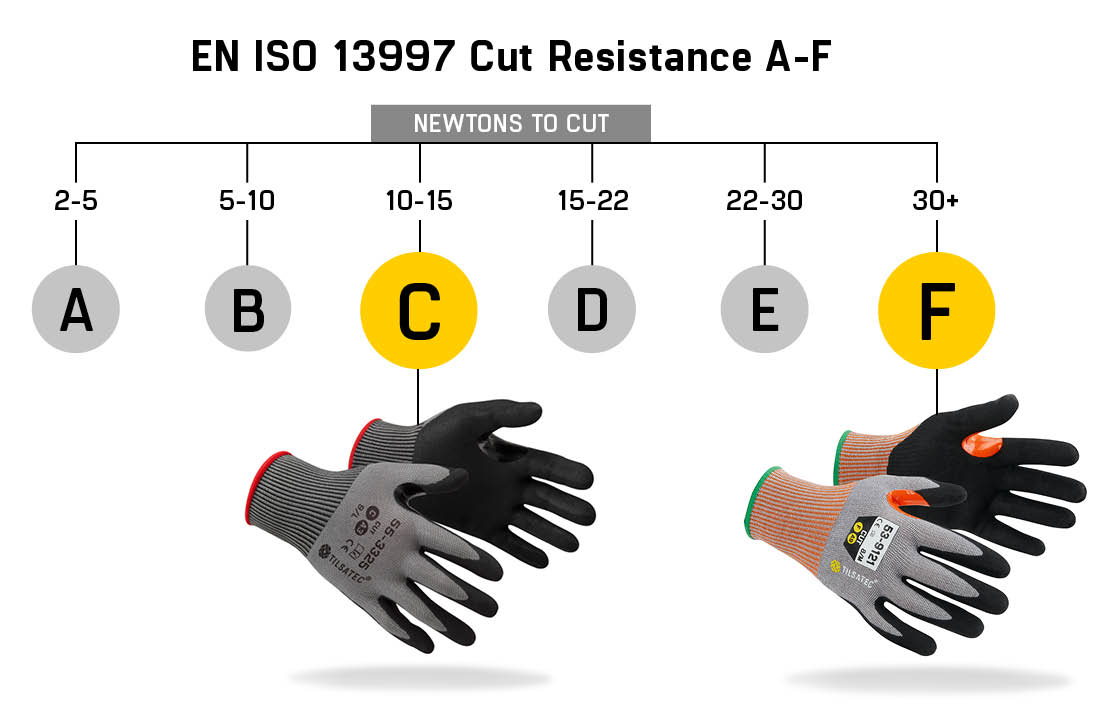
Cut Level C vs Cut Level F: What’s the Real Difference?
At a glance, both Level C and Level F gloves offer cut protection, but they are designed for very different risk environments.
Cut Level C
Cut Level C gloves are designed for moderate cut hazards where dexterity and comfort are still essential.
Typical applications include:
• Light metal handling
• Automotive assembly
• Construction tasks with limited sharp edge exposure
• General maintenance work
Across the Tilsatec Comfort+ range, these gloves are designed to deliver a balance of protection and flexibility, without compromising on wearer comfort during prolonged use. These gloves strike a balance between protection and flexibility, making them ideal for tasks where workers need to handle tools and components with precision.
Cut Level F
Cut level F gloves provide the highest level of cut resistance, designed for environments where sharp materials present a constant and severe hazard.
Typical applications include:
• Heavy metal fabrication and stamping
• Glass handling and recycling
• Waste and recycling operations
• Oil & gas and heavy industry
• Aerospace and advanced manufacturing
For applications requiring the highest levels of protection, products such as the Tilsatec 53-9121 go beyond standard Level F requirements. These gloves are engineered to offer exceptional cut resistance for the most demanding environments.
Choosing the Right Level for the Job
Selecting between cut level C and cut level F isn’t about choosing the “best” glove, it’s about choosing the right glove to protect against the risk.
Key considerations include:
• Severity of cut hazard – Are edges sharp, jagged, or continuous?
• Frequency of exposure – Is cutting risk occasional or constant?
• Dexterity requirements – Does the task require fine motor control?
• Comfort and wear time – Will gloves be worn continuously for long periods?
Over-specifying protection can reduce comfort and productivity, while under-specifying can increase the risk of injury.
Understanding the difference between cut level C and cut level F gloves is essential for choosing the right PPE. While cut level C offers a versatile solution for moderate risks, Level F is designed for more demanding environments where a higher level of protection is non-negotiable.
By understanding how ISO 13997 testing works and what each cut level represents, safety professionals can better match gloves to the task, helping them select the right solution from the Tilsatec range while improving safety and performance on the job.
Ready to find the right gloves for your application? View the coated cut range here